
Learned Optimism: Building the Mindset You Want to Have
A bad event is not just a bad event.
It becomes powerful because of the story we attach to it.
When something goes wrong, we do not simply experience the event itself. We explain it. We decide what it means. And often, those explanations become habits.
Martin Seligman’s idea of learned optimism is simple but powerful: optimism and pessimism are not fixed traits we are born with. They are patterns of interpretation. They can be practiced. They can be strengthened. They can be changed.
The goal is not to become blindly positive. It is not to pretend problems are not real. It is not to deny pain, failure, injustice, or difficulty.
The goal is to stop making setbacks heavier than they need to be.
When something bad happens, pessimistic thinking tends to make three mistakes:
It treats the setback as permanent.
It treats the setback as global.
It treats the setback as a deep personal verdict.
For example:
“I failed that pitch because I’m bad at this, and I always will be.”
That thought feels like realism, but it may not be accurate. It turns one event into a permanent identity sentence.
A more useful thought would be:
“That pitch went badly because I was underprepared and the framing was off. I can fix that next time.”
That is not fake positivity. It still owns the problem. It simply keeps the problem temporary, specific, and changeable.
That is the heart of learned optimism.
Not:
“Everything is fine.”
But:
“This is not the final verdict, and there is probably something useful I can do.”
The three dimensions of explanatory style
Seligman describes optimism and pessimism through three dimensions: permanence, pervasiveness, and personalization.
Permanence asks:
Do I believe this problem will last forever, or do I see it as temporary?
A pessimistic explanation says:
“This always happens.”
An optimistic explanation says:
“This happened this time.”
Pervasiveness asks:
Do I believe this problem affects everything, or just this specific area?
A pessimistic explanation says:
“I failed at this, so I’m bad at everything.”
An optimistic explanation says:
“This one area went badly.”
Personalization asks:
Do I believe this proves something defective about me, or do I look for specific causes?
A pessimistic explanation says:
“This happened because there is something wrong with me.”
An optimistic explanation says:
“This happened because of specific factors, some of which I can change.”
The difference matters because pessimistic explanations often create helplessness. Optimistic explanations create agency.
A mistake at work can mean:
“I always mess things up.”
Or it can mean:
“I missed this one thing. I need a better process.”
An argument in a relationship can mean:
“We are doomed.”
Or it can mean:
“We handled this badly today. We need to repair and discuss it.”
Low energy can mean:
“I’m falling apart.”
Or it can mean:
“I’m overloaded and tired. I need rest and reset.”
The event may be the same. The explanation changes the outcome.
Optimism is not denial
This is where learned optimism is often misunderstood.
Optimism does not mean pretending life is easy. It does not mean ignoring real obstacles. It does not mean blaming people for struggling. Some problems are genuinely hard. Some barriers are real. Some setbacks are unfair.
But even when difficulty is real, the question remains:
What meaning will I attach to this?
A pessimistic mindset says:
“This proves I am powerless.”
An optimistic mindset says:
“This is hard, but I still have some room to act.”
That room may be small. But small is not nothing.
Agency often begins with the smallest available next move.
The ABCDE method
Seligman proposed a practical tool for building learned optimism: the ABCDE model.
A — Adversity
What happened?
B — Belief
What did I immediately believe about it?
C — Consequence
How did that belief make me feel or act?
D — Disputation
Is that belief completely true? What evidence challenges it? Is there another explanation?
E — Energization
What changes when I see the situation more accurately?
For example:
Adversity: I received negative feedback at work.
Belief: I’m useless. I’m going to fail.
Consequence: Anxiety, shame, avoidance.
Disputation: Is that actually true? Or did I miss a specific expectation? What can I improve?
Energization: I can ask for clarification, fix the issue, and improve the process.
This is not about lying to yourself.
It is about refusing to let your first pessimistic thought become the judge, jury, and executioner.
Why pessimism spreads so easily
Pessimism is often easier to sell than optimism.
A pessimistic message can sound intelligent, cautious, and realistic. An optimistic message can sound naive, self-interested, or fake.
The pessimist often sounds like they are warning you. The optimist can sound like they are selling you something.
This matters culturally.
It is often easier to tell people:
“You are stuck because other people are holding you down.”
Than to say:
“Some things are outside your control, but your agency still matters.”
The first message is easier to hear. The second message is harder, but often more empowering.
This does not mean external barriers are imaginary. They are not. But a culture that only teaches people to notice barriers, and never teaches them to build agency, risks training helplessness.
We should be careful about what we feed our minds.
Books, stories, media, leaders, and communities all train our explanatory style. They teach us what failure means. They teach us whether struggle is a dead end or a beginning. They teach us whether we are fixed at birth or built over time.
We need more stories that build agency.
We need more examples of people who changed.
We need more reminders that a setback is not an identity.
Any real world data on what has been ‘learned’ recently?
This graph is a evidenced ‘learned helplessness’ AKA Learn Pessimism has been rising.
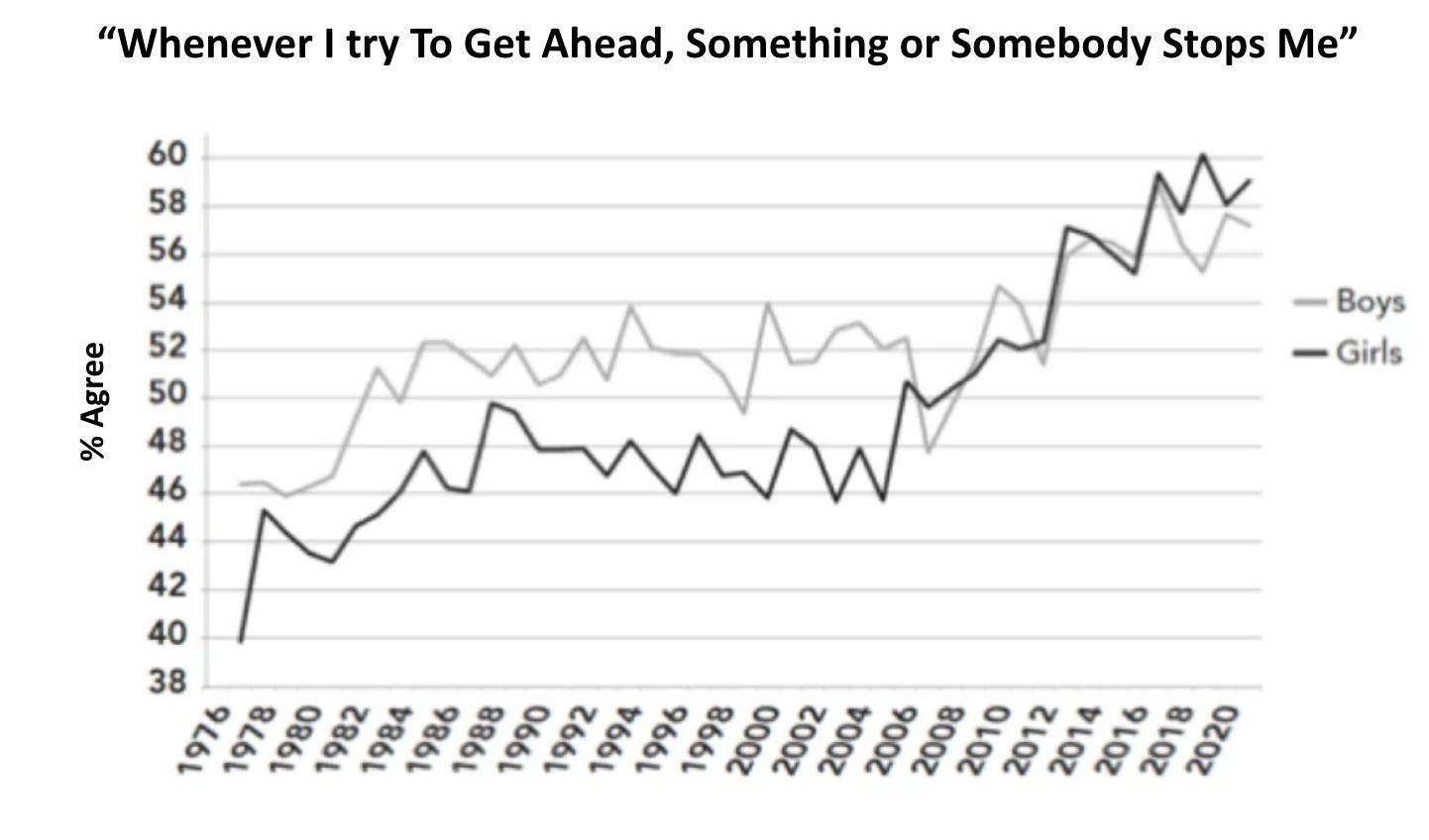
I think there is evidence that for society for the last 20 years there has been a net Learned Pessimism increase. I think we should try to reverse this and have net Learn Optimism :).
Jensen Huang, CEO of Nvidia.
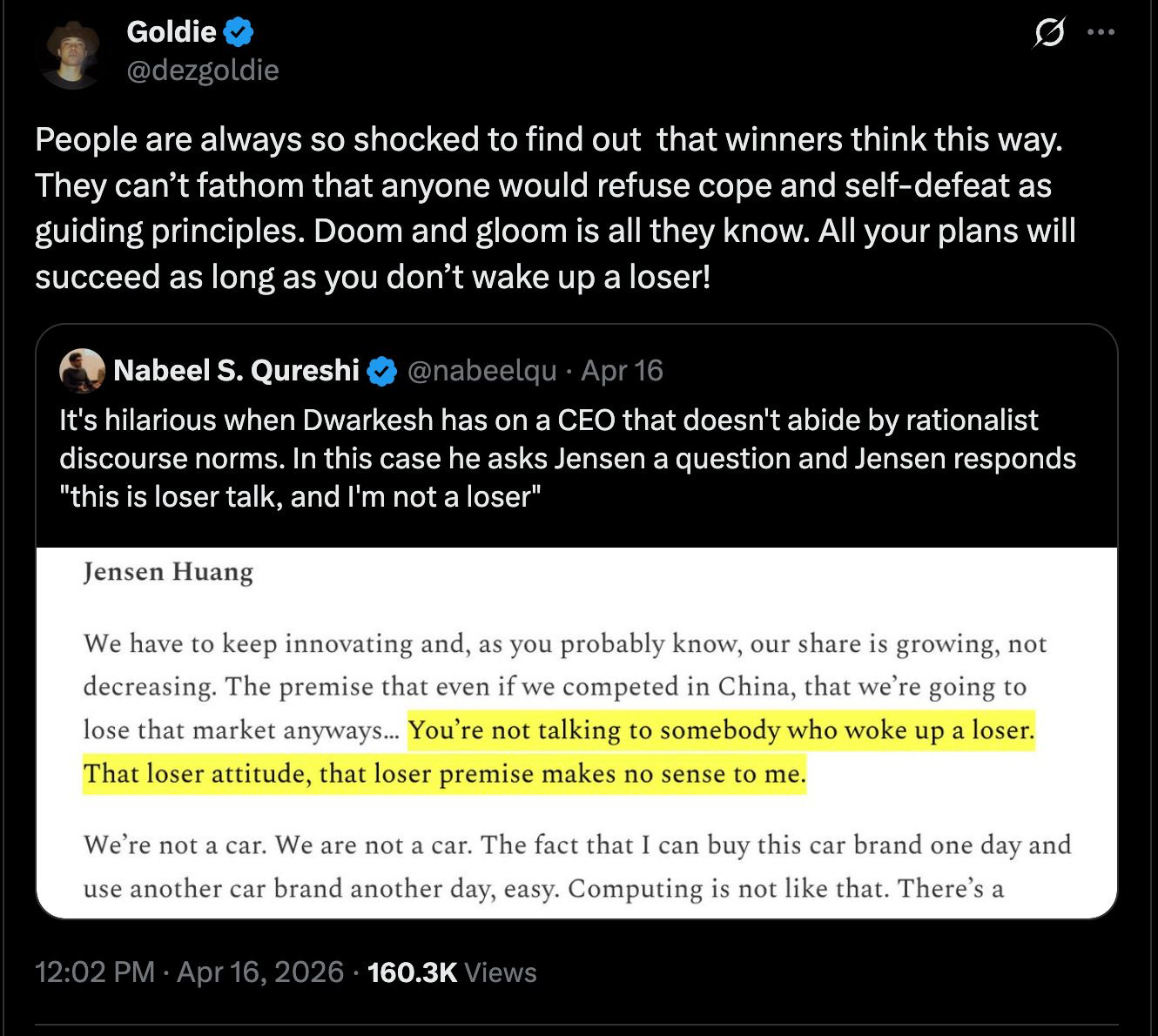
Loser attitude = Learned pessimism?
The takeaway
Learned optimism is not the belief that everything will go well.
It is the discipline of interpreting setbacks in a way that keeps action possible.
Bad day?
Do not automatically say:
“It is forever, everywhere, and all my fault.”
Try:
“It is this thing, this time, and I can do something about it.”
That single shift matters.
Because the mindset you practice becomes the mindset you live inside.
Build the mindset you want to have.