
Happiness = Reality – Minimum Acceptable Outcome. Happiness ≠ Reality – Expectations
Reading time: 5 mins
Happiness = Reality – Minimum Acceptable Outcome
Are happiness and greatness inevitably at odds with each other? Tim Urban, the writer behind Wait But Why, famously distilled this dilemma into a simple equation:
Happiness = Reality – Expectations
On the surface, if you want to be happy, you might think, “Just lower your expectations!” But that creates a new problem: how can you be great if you never aim high? High expectations are essential to achieving excellence, yet they can leave you perpetually dissatisfied if you fall short.
So, is there a way to reconcile ambition with contentment? I propose a new equation:
Happiness = Reality – Minimum Acceptable Outcome,
and you get to shape your reality by aiming high.
This blog explores why adjusting your “floor” for happiness—and still shooting for greatness—can help you lead a more fulfilled life. Or why a ‘Two Goal’ approach should lead to better outcomes than a ‘One Goal’ approach.
The Paradox: Greatness vs. Happiness
Aiming for Greatness
To be great, you need to set high expectations.
Sam Altman once said, “The only acceptable goal is to aim to be the best at what you do in the world.”
Today, there are more opportunities than ever—200 years ago in Western Europe, there were 400 jobs; now, there are more than 500,000. With so much potential, aiming for greatness seems natural and beneficial not just for you, but for society at large.
The Risk of Disappointment
High expectations can lead to perpetual dissatisfaction.
Tim Urban’s formula suggests that any gap between reality and huge expectations results in lower happiness.
As Warren Buffett once quipped, “If you want a happy wife, get someone with low expectations.” Yet many don’t want to sacrifice ambition just to be happier in the short term.
Hence, the big question: If you’re always pushing to be the best, can you ever be content?
The Reframe: Set Two Targets, Not One
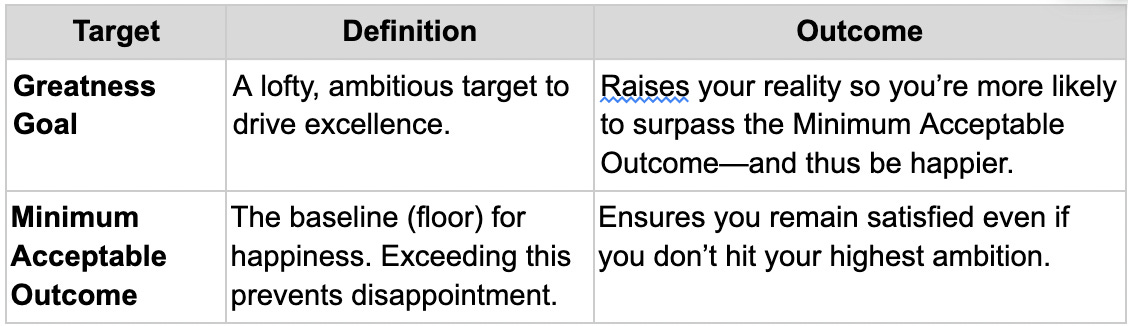
Target 1: Greatness Goal
Aim to be the best version of yourself—whether in your career, a startup, parenting, or friendship.
“Shoot for the moon,” as the saying goes, “and even if you miss, you’ll land among the stars.”
By aiming high, you increase the likelihood that reality (what you actually achieve) is elevated.
Target 2: Minimum Acceptable Outcome
Think of this as the “floor” for your happiness.
If you meet or exceed this baseline, you allow yourself to feel satisfied.
This stops you from being miserable whenever you don’t hit stratospheric goals.
With two targets in mind, you mitigate the all-or-nothing trap. Meeting your minimum ensures happiness, while shooting for greatness elevates reality, which further boosts your odds of satisfaction.
Jingle: “Don’t mope—set two hopes!”
Visual Model Time
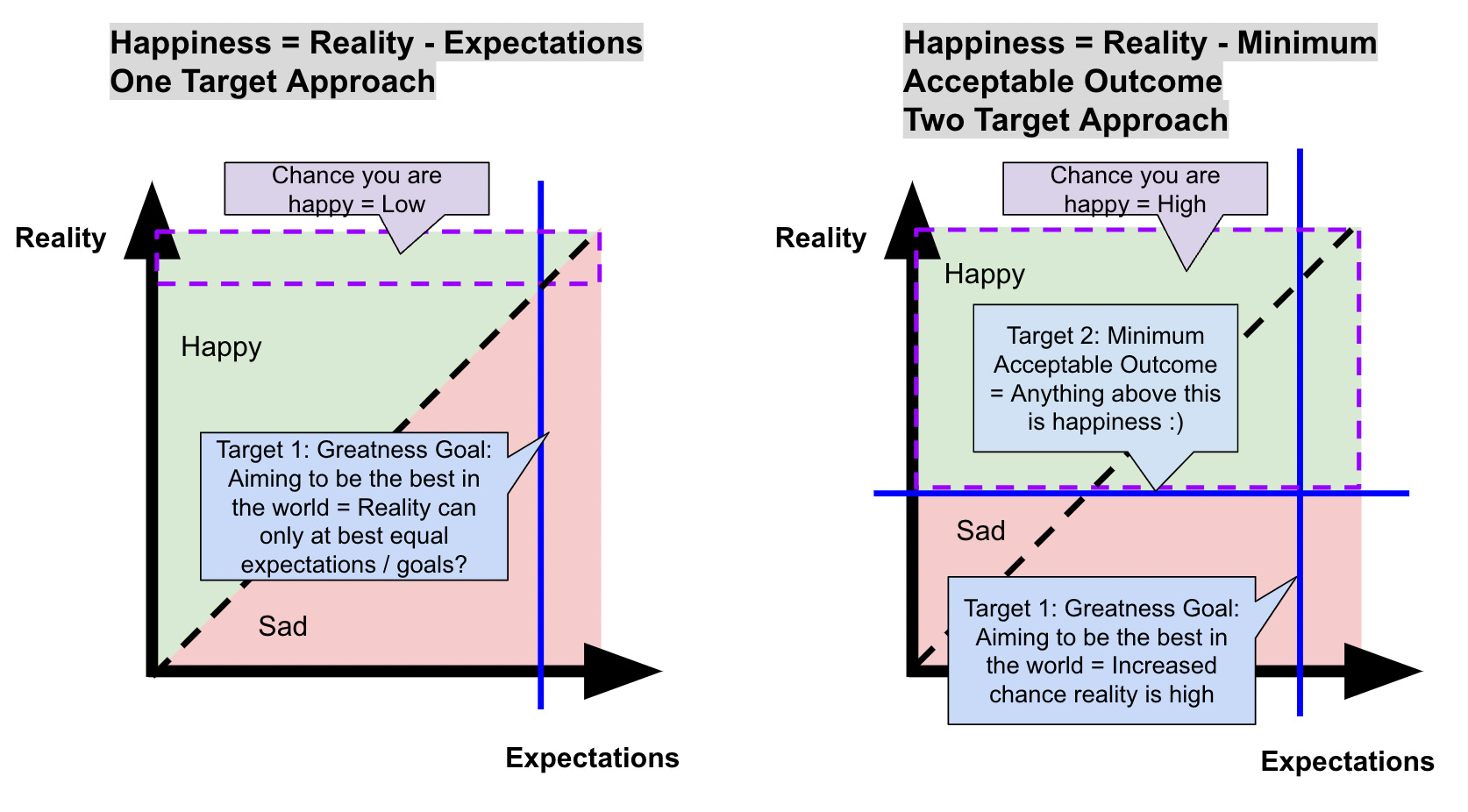
How The Two Target Approach Helps
Protects Your Emotional Well-Being
Setting a baseline means you won’t constantly compare your performance against a sky-high benchmark. You have a safety net of contentment, even if you haven’t crushed the absolute highest goal.Encourages Ambition
You still have a “greatness goal” that motivates you to stretch beyond your comfort zone. The drive to excel remains intact.Increases the Chance of Happiness
Happiness = Reality – Minimum Acceptable Outcome
When your reality surpasses this floor, you feel good. The higher you push your reality with ambitious targets, the more likely you are to exceed that minimum.
Real-World Examples - Two Target Approach
Early-Stage Startup
Greatness Goal: Top 1% metrics for your business model and stage.
Minimum Acceptable Outcome: Keep the company alive—hit essential milestones that ensure you’re not dead in the water.
Even if you don’t break into the top percentile, you can still feel satisfied that you’ve moved the company forward and stayed in the game.
Career Progression
Greatness Goal: Get promoted as fast as possible—say, within 12 months.
Minimum Acceptable Outcome: Achieve an acceptable performance grade that keeps you in good standing.
Maybe you miss the early promotion by a few months; if you still maintain a solid track record, you’ve surpassed your baseline, thus avoiding complete disappointment.
Personal Growth (e.g., Fitness)
Greatness Goal: Compete in a 10K race and finish in the top 10.
Minimum Acceptable Outcome: Simply complete the race without injury and feel good about your performance.
You might not land in the top 10, but if you finish strong and beat your personal best, you’ve still exceeded your minimum outcome.
How to Implement the Two Target Approach
Identify Your “Greatness Goal”
Be as lofty as you wish.
It could be to start your own business, become a top athlete, or excel at your job.
Define Your “Minimum Acceptable Outcome”
This should be concrete and achievable—staying employed, hitting basic revenue targets, completing a challenging task on time.
It’s not something that requires minimal effort—it’s just the level at which you can still maintain satisfaction.
Monitor Your Reality
Keep track of results and benchmarks.
Whenever your reality dips below the baseline, it’s a signal to adjust your strategy or invest more effort.
Acknowledge Victories Along the Way
Celebrate not only hitting your loftiest goals but also securing the minimum milestones.
This positive reinforcement keeps you motivated and prevents burnout.
Embrace the Paradox
James Cameron once said, “If you set your goals ridiculously high and it’s a failure, you will fail above everyone else’s success.” The lesson? You can aim high and still be happy—as long as you know where your baseline is.
Happiness and Greatness Aren’t Opposing Forces
They become mutually reinforcing when you anchor your happiness in a minimum acceptable outcome while driving your reality up through ambitious dreams.It’s Not Just About Lowering Expectations
It’s about managing them in a way that keeps you motivated and inspired, without setting yourself up for perpetual frustration.
Final Thoughts
You don’t have to choose between a low-expectation life of guaranteed contentment and the roller coaster of perpetual “almost-but-not-quite” disappointments. By maintaining two targets—a “floor” to safeguard happiness and a “ceiling” to drive greatness—you can ensure that your journey toward excellence is one that also nurtures your well-being.
So the next time you set out to conquer your next big goal, ask yourself: What is my minimum acceptable outcome? By doing so, you’ll free yourself to aim for the stars without losing sight of the simpler joys along the way. After all:
Happiness = Reality – (Minimum Acceptable Outcome),
and you get to shape your reality by aiming high.
Related blogs and articles